Accelerated service life testing - reliability in fast motion.
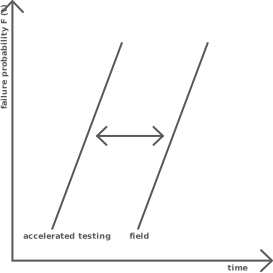
Accelerated life testing aims to test a product in a shorter period of time. To do this, the product is subjected to stresses in the test that are higher than those that occur in real field operation.
Particularly in the case of short development cycles and very high product life requirements, the use of accelerated life testing is the only way to ensure field reliability during development – especially in the case of spontaneous failure types.
Requirements and limits
When defining accelerated tests, it must be ensured that the increased loads do not trigger any failure mechanisms that are not relevant in the field. Only then can the results be meaningfully transferred to real conditions.
An essential prerequisite for the transfer of accelerated test failure times to field conditions is knowledge of the so-called shirring factor. If this is not known, it can be determined using appropriate preliminary tests.
Areas of application
The topic of accelerated life testing can essentially be divided into the following three applications/objectives:
- Accelerated testing to save time and money
- Accelerated testing to improve products by identifying and eliminating as many potential failure modes as possible, including those that are not relevant in the field
- Accelerated testing in production for effective detection of good and bad parts

Highly Accelerated Life Testing (HALT)
Highly Accelerated Life Testing (HALT) is suitable if the aim of the tests is not primarily to determine the field service life, but to make fundamental improvements to the product. This method is primarily used during development – especially for electronic or electromechanical systems. Systems are subjected to combined loads such as temperature, temperature strokes and vibration.
- The gradual increase in load provokes soft errors (functional limitations) and hard errors (physical failures).
- If a component fails, a root cause analysis is carried out to identify the cause of the fault.
- Based on this, suitable remedial or improvement measures are defined.
With HALT, the stress exaggeration (gathering) is so high that a field life prediction can generally only be derived to a limited extent, if at all.
Highly Accelerated Stress Screening (HASS)
Highly Accelerated Stress Screening (HASS) is an extension of accelerated testing. This method is used in production. In contrast to HALT, the product is subjected to a stress that good parts can withstand without being destroyed, while defective parts are recognized as defective. The decisive success factor of HASS is the determination of the optimum load level.
Our services
- Collection/provision of the main product failure modes before the actual tests are carried out
- Identification of harmful influencing factors
- Definition and statistical evaluation of test programs to determine shirring factors
- Field service life prediction based on accelerated downtimes
- Support for HALT and HASS initiatives
In combination with other methods
