
Ensure reliability - shorten development times.
Product service life is a decisive quality feature in many industrial sectors. If failures due to ageing or wear occur too early, this usually affects all products in the field – resulting in expensive customer service measures, financial losses and damage to the company’s image.
The purpose of service life validation is to verify the required service life target as efficiently as possible within the development period. Various test methods are available for this purpose, which are individually adapted to the respective boundary conditions. A key aspect in this area is the strategy for shortening test times.
Principles of test planning
Test planning takes into account the defined and verifiable service life target. This target consists of a maximum permissible proportion of failed components after a certain service life – supplemented by the required reliability of the verification.
In many companies, test planning is based on binomial statistics. However, in the case of high reliability requirements, this leads to very high testing costs.
Example:
To verify a service life requirement of B5 = 10,000 hours with a 95% confidence level, 59 parts must be tested for 10,000 hours without failure – an enormous effort, which is often required in the supplier sector in particular.
There is therefore great interest in reducing the testing effort by using alternative methods.
Options for shortening the test time
Several approaches are available to reduce the effort involved:
- Consideration of variable test times
- Accelerated testing (no HALT)
- Application of statistical methods
- Use of degradation modeling
- Use of prior knowledge and practical methods
The choice of method depends on this, among other things,
- whether it is a known or new product technology,
- and whether the failure behavior is observable or spontaneous.
Test with variable test times
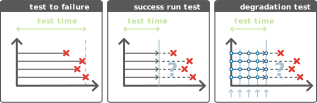
If the testing of components is continued beyond the required service life (until failure), the number of test subjects can be reduced.
This procedure makes optimum use of the additional information from longer service lives.
Tests under increased loads
The so-called refinement method is used to make statements about product reliability in a shorter time. If used correctly, considerable reductions in test time can be achieved. The challenge lies in the correlation between testing and field use.
The so-called shirring factor describes this correlation – its determination is the real challenge when planning accelerated reliability tests.
Important:
The loads generated in the test must actually excite the failure mechanism in the field. Otherwise, early failures will occur, but these are not relevant to the field and are therefore not suitable for predicting service life.
Statistical methods
Special statistical methods exist for the evaluation of censored samples, such as:
- Sudden-Death Testing
- Evaluation of censored data
These procedures use all available information to achieve the maximum possible reliability statement – including failure-free running times.
Degradation Modeling
In many cases, the degradation of a quality characteristic can be observed directly, e.g.
- the wear of linings or
- the internal resistance of a battery.
Multiple intermediate measurements are used to track the progress and create a model that enables forecasts to be made about the time of end-of-life.
This allows a predicted service life distribution to be created – often combined with various increased load levels.
Prior knowledge and practical methods
In practice, we encounter very different framework conditions with our customers. We react flexibly to this – through scientifically sound adaptations of known methods. Our experience has led to several tried-and-tested methods that go beyond the state of the art, e.g:
- Use of prior knowledge to reduce test time
- Determination of precise shirring factors through tests on products already aged in the field
Our services
- Definition of service life tests including all preparatory work
- Identification of possibilities for shortening test times under individual boundary conditions
- Determination of refinement factors and forecast models
- Support in representing the approaches to customers
In combination with other methods
