
Identify deviations – systematically increase safety.
The HAZOP method (Hazard and Operability Study) is a proven method of system analysis and originated in safety-critical areas, particularly the chemical industry.
In German-speaking countries, it is also known by the abbreviation PAAG – Prognosis, Finding the Cause, Assessing the Effects, Countermeasures.
Objectives and benefits of HAZOP
HAZOP has proven to be an extremely efficient method for achieving the following objectives:
- Increasing the reliability and functional safety of products and processes
- Reduction of warranty and goodwill costs
With its structured approach, HAZOP helps companies identify deviations and risks at an early stage – even in complex systems.
Deviation scenarios as a key element
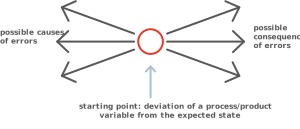
The core of the HAZOP analysis is the definition of deviation scenarios (deviations) from system parameters such as pressures, flow rates or operating materials in comparison to a target state.
The methodological advantage lies in the targeted description of specific scenarios using defined keywords. These promote the abstract consideration of a system and make it possible to uncover even unknown or unexpected failure scenarios – often far beyond the empirical knowledge of the developers.
HAZOP can be used to consider a wide variety of technologies, e.g.:
- mechanics
- hydraulics
- Control and regulation technology
Requirements for successful HAZOP projects
The basis of every successful HAZOP project is a suitable system description with clearly defined attributes and system elements to which the keywords are applied. Without this basis, ambiguities can arise that jeopardise the success of the analysis.
HAZOP in combination with other methods
The HAZOP method can be seamlessly integrated into existing FMEA projects, where it significantly increases efficiency. Using HAZOP deviation scenarios makes risk analysis more systematic, comprehensive and meaningful.
Our services
- Preparation of HAZOP projects (system description, completeness check, definition of elements and attributes)
- Moderation and documentation of HAZOP meetings and projects
- Contribution of our experience with typical faults in technical products
- Integration of the HAZOP methodology into FMEA projects
- Monitoring and implementation of defined prevention measures
- Training and empowering your employees in the HAZOP methodology
In combination with other methods
HAZOP is often combined with FMEA/FMECA and fault tree analysis (FTA).
While FMEA evaluates causes and FTA identifies system dependencies, HAZOP provides valuable additional perspectives on deviation scenarios and process risks – especially in safety-critical industries such as chemical engineering and process engineering.
