Logo JHP — Beratungsgesellschaft für Produktzuverlässigkeit
Weibull analysis for the statistical evaluation of failure behavior

Weibull analysis

Understanding failure behavior - quantifying reliability.

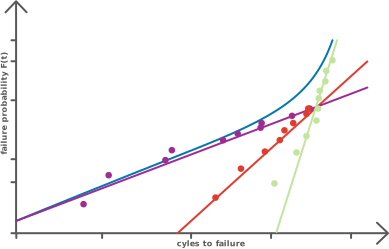
Weibull analysis is a quantitative method of reliability engineering. It is used to statistically record the failure behavior of technical products and describe it using the Weibull distribution – named after Ernst Hjalmar Waloddi Weibull. The method is always used when a mathematical model is to be derived on the basis of real failure data, which is then used for further analyses or forecasts.

Fundamentals of the Weibull distribution

The Weibull distribution describes the failure event with two parameters:

The shape parameter is particularly interesting from a reliability point of view: it allows the observed failures to be divided into the three classic areas of the bathtub curve.

This classification is important for defining targeted improvement measures or determining maintenance strategies for specific components.

Application of the Weibull analysis

Weibull analysis is used in various phases of the product life cycle:

Weibull analysis for the statistical evaluation of failure behavior

Statistical certainty and confidence intervals

A key aspect of Weibull analysis is the consideration of the confidence level. Since lifetime data usually comes from small samples, every evaluation is subject to statistical uncertainty. Conclusions drawn from a limited amount of data about the entire product population are therefore always given with a certain probability or confidence interval – a basic prerequisite for reliable decisions.

Our services

In combination with other methods

Weibull analysis is closely linked to field data analysis, reliability testing and warranty management. Together, these methods enable the determination, evaluation and prediction of failure behavior – from development to field use.

contact JHP für Beratung zu Produktzuverlässigkeit und technischen Systemen

Speak with our experts