Logo JHP — Beratungsgesellschaft für Produktzuverlässigkeit
Robust design for developing stable and durable products

Robust design

Ensure quality - reduce costs.

A key objective of product development is to ensure the functionality of a product in different areas of application and at the same time make it insensitive to the effects of fluctuations. This goal can be achieved through various development approaches – the most effective of which is robust design.

Origin and philosophy

The concept of Robust Design is based on the development philosophy of Japanese engineer Gen’ichi Taguchi. His approach differs fundamentally from traditional methods of product development: instead of exclusively optimizing tolerances, Robust Design focuses on the systematic design of parameters in order to minimize the variance of quality characteristics.

Parameter Design and Tolerance Design

Robust design takes into account that the scattering of quality characteristics cannot be controlled by tolerances alone. It is more efficient to first define the nominal values of the design parameters in a targeted manner (parameter design). Only when the required specification limits are exceeded are the tolerances tightened (tolerance design). Robust design therefore has a close interface to statistical tolerancing.

Robust design for developing stable and durable products

Principle and objective

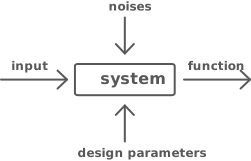
The basic idea is to ensure the quality of the system output without unnecessarily restricting tolerances, as tight tolerances usually incur high costs.

The focus is on exploiting non-linearities and interactions within the physical system relationships. This often allows quality improvements to be achieved while simultaneously reducing costs – for example, by eliminating expensive components such as additional cooling equipment.

Methodological basis

The core of robust design is the use or determination of a system behavior equation, often based on the Design of Experiments (DoE) method. Based on this, the optimum nominal values of the design parameters are determined – taking cost and quality criteria into account.

Our services

We apply the principles of robust design specifically to your product and demonstrate them through detailed analyses:

In combination with other methods

Robust Design is closely linked to Design of Experiments (DoE), as statistical test planning forms the basis for determining the optimum parameters. Together with service life models and accelerated life testing, a comprehensive approach is created to develop products robustly and economically right from the start.

contact JHP für Beratung zu Produktzuverlässigkeit und technischen Systemen

Speak with our experts